
A cyberattack or network anomaly in an industrial environment can halt production for days. However, in many telecom and IoT systems, these issues are still detected minutes or even hours too late.
In telecom networks, a congestion spike or service disruption doesn’t just affect one endpoint; it can degrade performance for thousands of consumers at once. In IoT environments, delayed visibility means fleets, factories, or connected devices can continue operating in compromised conditions without immediate awareness.
As industrial systems become more connected through telecom networks and IoT, the ability to monitor and respond to events in real time is no longer optional.
It’s foundational.
In this article, we’ll explore what real-time data streaming is, how it transforms operational visibility, and how Evoura can support your transition to real-time intelligence.
So, what exactly is real-time data streaming?
In a nutshell, real-time data streaming for telecom and IoT networks enables organizations to capture and process data as soon as it’s generated. Some common examples include IoT sensor readings, fraud detection, and even social media feeds.
It’s also an improvement on the older batch processing.
Batch vs. Real-time data
Many businesses still use batch processing, but comparatively, it’s quite inefficient.
Traditional batch processing collects and analyses data in chunks, often minutes or hours after it’s generated.
Real-time data streaming, by contrast, turns network telemetry, device updates, and sensor signals into immediate insights for monitoring, automation, and predictive decision-making.
The benefits of real-time data streaming for Telecom and IoT networks
Real-time data streaming offers numerous benefits for telecom and IoT networks; in fact, 44% of businesses analyzed in Business Wire’s 2025 Data Streaming report report a 5x return on investment (ROI) from data streaming.
Here are some of the near-immediate benefits you can anticipate:
- Immediate visibility: Detecting anomalies, performance issues, or security risks as they occur. As an example, Kaspersky, the popular anti-virus provider, noted that improved monitoring and detection systems reduced response time to high-security incidents by 17%.
- Operational efficiency: Optimizing networks, devices, and processes continuously rather than having delayed reactions.
- AI-driven insights: Feeding machine learning models with updated data for predictive maintenance and more efficient automation. Predictive maintenance can reduce machine downtime by up to 50%.
- Scalable performance: Handling millions of events per second across complex telecom and IoT ecosystems without delay.
Building smarter industrial operations
Industrial automation is entering a new phase, one where real-time data is becoming the backbone of operational decision-making.
Across Telecom and IoT environments, millions of events are generated every second:
- Network telemetry
- Device signals
- Machine status updates
- Sensor readings
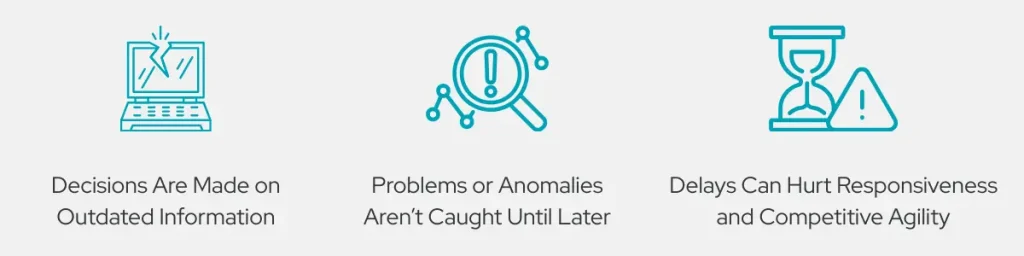
Yet as we mentioned earlier, many organizations are still trying to manage this reality with batch analytics or fragmented monitoring tools.
In industrial automation and smart manufacturing, that delay matters.
A network anomaly detected 10 minutes later can mean:
- Production downtime
- Safety risks
- Supply chain disruption
- Costly maintenance
This is why real-time data streaming architectures are becoming critical across telecom networks and IoT ecosystems.
But technology alone is not enough.
Where data governance falls into this
Without the right data governance, real-time data quickly becomes noise instead of insight.
What we see in many network and IoT environments:
- Key data is trapped in siloed tools, slowing decisions
- Different systems report things differently, making insights unreliable
- Teams aren’t aligned, leading to delays and inefficiencies
- Limited visibility increases risk and makes issues harder to catch early
To get real value from real-time data, organizations need to treat it as a core business asset. That means:
- Clear ownership of data, so accountability is not lost
- Consistent data across systems, so everyone is working from the same truth
- Strong governance, so data can be trusted for decisions
- Systems built for speed, so insights can drive action in real time
Turning real-time data into action
When these foundations are in place, something powerful happens.
Networks, devices, and machines stop being isolated systems and start becoming intelligent ecosystems. This is where telecom infrastructure, IoT connectivity, and industrial automation converge. Real-time data streaming platforms become the nervous system of modern operations.
How mature is your organization’s real-time data strategy today?
Reach out to us today and turn that noise into game-changing insights.